
Catastrophes are Commodities
and it makes me uncomfortable.

Some Ways to Help:
Please consider donating to help Central Texas flood recovery:
In geospatial, it’s rarely good news. Weather data and satellite imagery never accompany “senior dog who was in the shelter for 2 years adopted” articles. Instead, earth observation images are often used to observe geopolitical and natural upheaval and the accompanying death and devastation. This is an important function: it helps bring awareness to just how devastating conflict and natural disasters can be. This function comes with an implicit responsibility: when your pixels represent real lives, empathy and accountability must guide your messaging and actions.
I’ve noticed a concerning trend in the industry recently where sharing information and raising awareness quickly morphs into engagement farming and marketing. If you’re in the business of information the line is unfortunately blurred; but when a tragedy such as the Kerr County/Texas floods happens there seems to be pervasive eagerness to point at it and exclaim “Ha! Our data showed this would happen, and it did!”, forgetting in the process that their pixels are people.
Companies instinctively soften this opportunistic marketing with with the equivalent of corporate “thoughts and prayers”: this can take the form of a call to action (“we must do better”), or an expression of sadness (“it is with a heavy heart…"). These thoughts and prayers appear to absolve the company of potential misgivings concerning their apparent enthusiasm. To illustrate my point, here are some examples of what I perceive as disaster opportunism, recently posted on LinkedIn
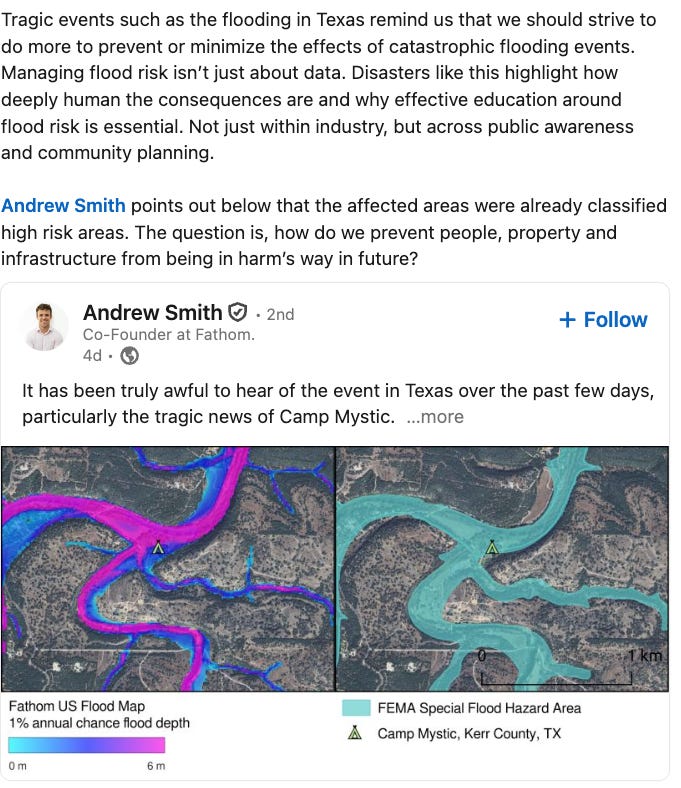
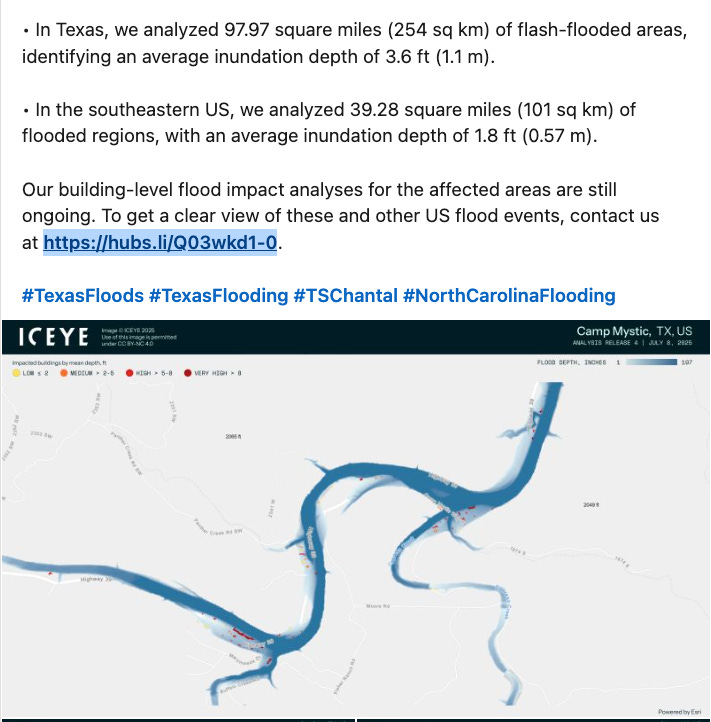
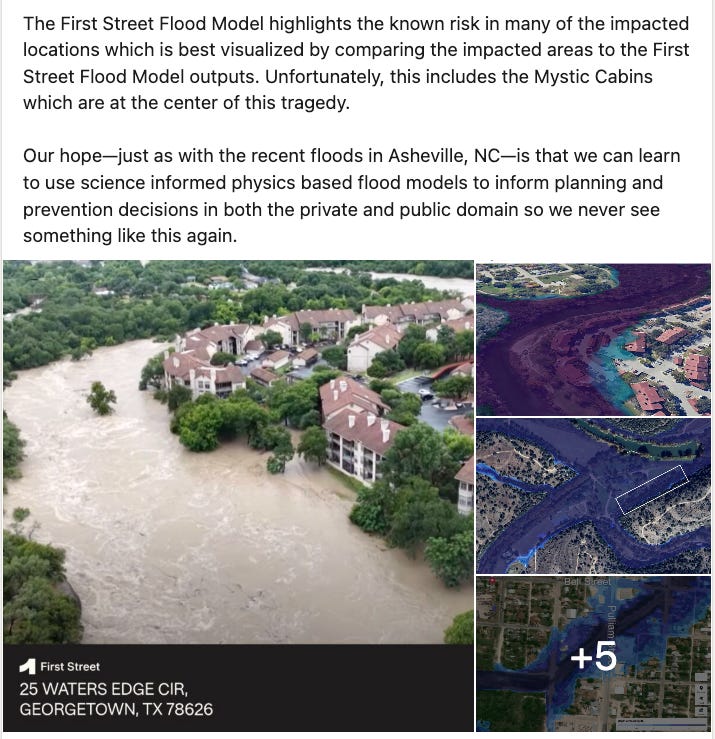
All of these examples are informative: they show proprietary data in order to help highlight the effects of the floods. Yet I still feel uneasy with these posts: their purpose is clearly to highlight the utility of proprietary data/analysis, by leveraging the occurrence of the Texas floods. One has to wonder whether these moments incentivize profit-driven behavior at the expense of empathy.
Rules concerning corporate messaging are complicated in the geospatial world. When your pixels are people, I believe there is an additional responsibility to tread delicately. If companies would like to do better, I’ve compiled a list of things they can do to offset the surely unintentional eagerness of their marketing and genuinely help:
Provide your data for free to journalists, and let them do the talking.
At the top of your post, include links so your readers can donate/help to funds specifically set up to address the catastrophe.
Provide your data for free to emergency response teams.
Make your data surrounding this particular catastrophe open, so that the wider public can use it and inspect it.
Provide concrete ways we can ‘do better’: for example if you have flood risk data, overlay it with overture maps data and identify the highest building density areas that experience risk similar to Camp Mystic. Publish this information. (This is a made up example, I’m sure you can think of better things to do!).
It’s not all bad though: Floodbase, for example, shared their data with journalists at The New York Times without overtly marketing their services during the tragedy:
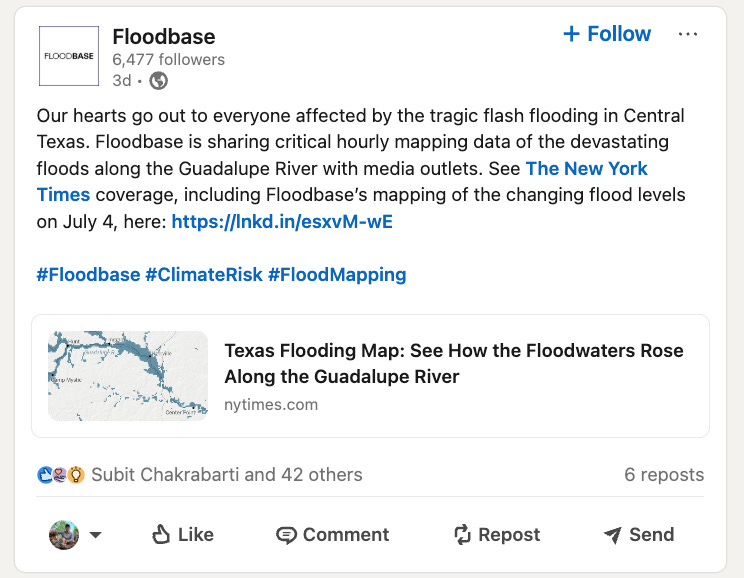
Is this entirely altruistic? No, but at least they provided the data for free to journalists and helped provide useable, informative maps of the event to the public. I think this is a much more palatable form of marketing when it comes to catastrophes. I should also note that First Street did provide their flood zone maps to NPR, and it appears ICEEYE’s data supported disaster response coordination. While these are commendable acts, the blending of genuinely helpful actions with overt marketing still feels somewhat tone-deaf and unsettling.
We can’t take empathy and good vibes to the grocery store: companies have to sell their product to survive, and sometimes that product is forecasts and observations of death and destruction. Profitability is necessary, but I do hope companies in this space can strike a more careful balance between their business interests and genuine empathy toward those affected.
This criticism isn't limited to corporations: I’m guilty of the same pursuit of visibility. When these types of tragedy strike my immediate reaction is some variant of “I should write about this on my blog”, and my motivations are probably more self-serving than altruistic. Earlier this year, following the Palisades fires, I wrote a post demonstrating drought calculations using Google Earth Engine. While I hope this contributed valuable tools and insights, reflecting honestly I recognize there was also a rather large element of self-promotion. I also of course note the irony of writing a ‘meta-post’ about this very same subject.
When our pixels are people, it's vital that we continually ask ourselves: Are we genuinely adding value to important discussions, or merely capitalizing on tragedy for visibility?
Thoughtful.
I value the empathy shared by geospatial but it does feel phony (or cringe).
If you're an individual sharing your commodity amidst catastrophe, it's going to come off as phony no matter what (especially based on your social platform of choice). But it is important to present yourself as a real phony and not a fake phony. I can't really add much to faceless company posts as these are just phony, like Christopher said not altruistic.
It is definitely vital to serve actual people rather than just serving statistics/demographics, but this is where the moral quandry creates a fork in the road.
is it that informative geospatial is not presented in the correct way?
Or rather the inaction of helpfulness to those in need?
Definitely interested in seeing new ways to serve communities before and after disasters. Increasing resilience is one thing that is evolving [through geospatial decision-making] but innovation in giving back [to communities] is not growing proportionately to the technology in anaylsis and inference.
Valid and I get where you’re coming from. I too have had the urge to market my company when events of significance occurred in the past - we didn’t do it, and purely because we weren’t ready yet to give a fully functioning product for a user - in case they reached out (commercials not even in the discussion). But we have all seen some cases where mock-ups and manually-assembled datasets are put out on social media with claims of products already available to use.
You gave examples of more mature companies - and there is another part of the spectrum that we need to speak about too!
On another note, an ideal world would be one where businesses state the disasters they helped avert, mitigate or coordinate saving of lives and reduction in loss of property. This could be the “senior dog who was in the shelter for 2 years adopted” moment for geospatial - but we all know how hard it is to get there.